If something works, then we will persist in doing that something. We may even try to enhance or extend that something. In fact, the more we can do of that something, the better it should be for us. It’s tried and tested. Why would we do anything different?
This is not only a natural instinct, but it also explains why, in Nature, when comparing species, there’s so much variety, so many unique characteristics, so much that is extraordinary.
Giraffes with their long necks; camels with their humps; narwhals with their lengthy tusk; chameleons with their darting tongue… the remarkable, the exceptional and the unusual.
In producing this mix of features, genetic mutation brings about creativity; genetic adaptation intensifies it.
The process begins when a genetic mutation is identified within a species as being advantageous or beneficial, thus making it desirable and sought after. A species will then seek to maximise this advantage by promoting that mutation through adaptation. It becomes the major factor – sometimes the only factor – in the selection of a reproductive partner. Those with the desired or most developed mutation become more successful in reproducing. As a result, that particular genetic trait is more likely to be passed on to future generations; it is more likely to become both more dominant and more prominent.
With regard to the intensification, when a genetic trait, arising through mutation, is recognised as being beneficial, a species will embrace it and then endeavour to pursue its elaboration to its limit. Why wouldn’t it? If something is helpful to an individual’s survival, well-being or prospects, then that individual is going to at least maintain that something and, given the opportunity, possibly even seek to further that something.
That’s how the evolutionary process works. It’s self-perpetuating; it’s self-expanding.
The more attractive a genetic trait is, the more that individuals who possess it are going to flaunt it, which – as a stand-out feature – will make it, and them, more attractive, and as a consequence, it will make those individuals more reproductively successful. That genetic trait is thereby advanced, becoming both more widespread and more pronounced. In so doing, it also becomes even more desirable.
With an established direction and a gathering momentum, there is therefore a natural tendency for genetic traits to intensify in terms of their conspicuousness.
It is not that different from the movement of dunes in a desert or the changing of a coastline through sedimentary deposition. The process begins with a trigger – something to cause an initial deposit. Once started, those deposits will then accelerate and accumulate until the landscape is reshaped.
Sometimes that mutational trigger can seem quite incomprehensible, even quirky. For instance, male hooded seals will blow a bright red balloon out of their nostrils to attract a female, or crested auklets will proudly display their impressive quiffs to demonstrate their genetic quality. These are both mutations that, for reasons unknown, have acquired importance in the selection of a reproductive partner and have undergone intensification to become the dominant features in determining an individual’s desirability within the species.
There are a number of reasons why such off-beat adaptations may proliferate and even become the dominant factor in partner selection:
- A species may be aware of a mutation but may be unsure whether or how a particular genetic trait could be beneficial. Individuals might therefore be attracted to it just to be on the safe side. It might be a good thing to have. It might be better to have it than not to have it.
- As described, the adaptation process itself will push creativity to extremes. Once a mutation gains a foothold in a species, a natural process of intensification ensues. Other genetic features can easily be overshadowed and subjugated by a dominant trait, however odd that trait may be.
- We should not overrate our own knowledge of these matters. We may simply not be aware of how specific mutations may be beneficial. We should also note that features need not be beneficial. They only have to convey a perception of having some real advantage.
- If an individual does not possess the conventional attractive qualities associated with a species, then, if they are to reproduce, they will have to demonstrate that those qualities which they do have may be advantageous. In so doing, should they succeed, others will perceive benefits in these qualities and, in this way, new desirable genetic traits can be established.
- Some individuals might actually be attracted to the unusual or the different. It happens within humanity; why shouldn’t it happen in other species?
- It is not always about which individual has the best qualities to help with survival; it is, quite often, more about which individual others think has the best qualities to help with survival. If an individual with a particularly unusual genetic trait becomes the pack leader, others will try to determine why. They may go on to consider that the unusual genetic trait may have had some bearing on the matter and therefore decide that it is a trait that should be considered attractive.
- When choosing a reproductive partner, some genetic traits may not be observable and may therefore be unconsidered in the mating process. They may only emerge later, when, having acquired a critical mass, they have a momentum of their own.
Most of the time, however, the adoption of particular courses of evolutionary development – whether that be physical or behavioural – is based on real, identifiable advantages – usually relating to some aspect of survival (the acquisition of food, protection from predators or as a defence against an environmental threat).
The most obvious and most common example of this is the reproductive dominance of the strongest and fittest – the alpha male is able to have his pick of the females. To become the alpha male, an individual must be stronger than the current alpha. Species development and intensification are thereby achieved.
Once a species has found its evolutionary path – its niche in Nature – it will then seek to pursue it to take maximum advantage. Why wouldn’t it? If an action gets the desired result, then it’s only logical that this action should get repeated.
The survival of a species requires this kind of reproductive focus. In an ever-challenging, ever-changing environment, if a species does not strengthen its genetic position, its existence may be threatened. This is what drives a species to seek to intensify its genetic advantage.
We can observe how humanity, having embarked on a societal evolutionary course, is dependent on society and demands an ever-increasing role for it. Society – our evolutionary niche – will naturally intensify. It will grow and spread; it will become more involved in our individual lives; it will become the dominant power and authority on what is genetically acceptable.
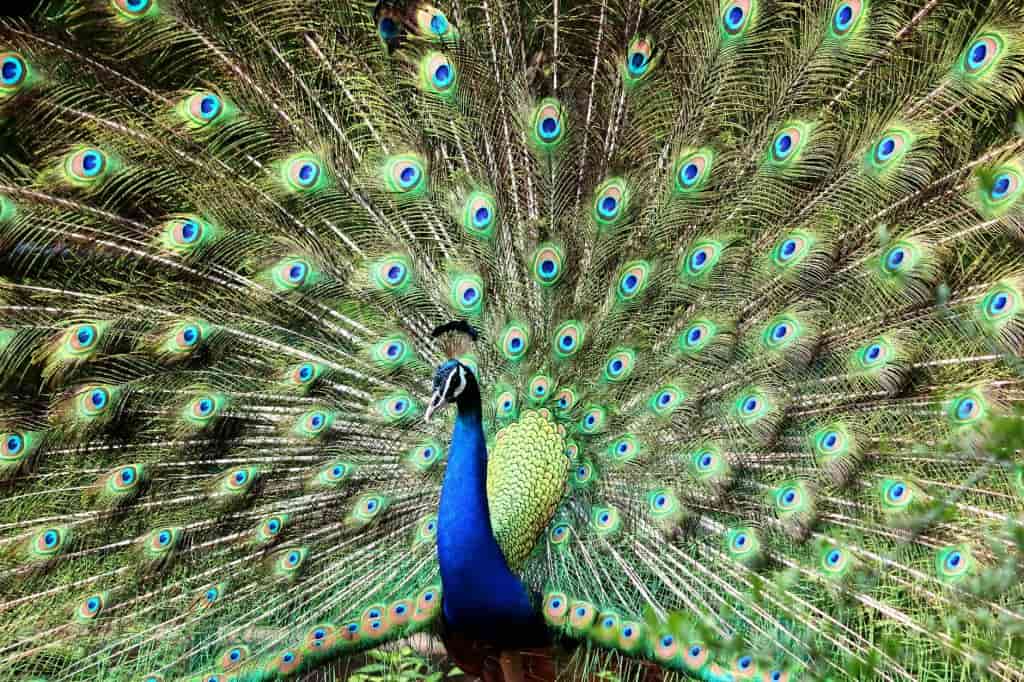
The danger with genetic intensification is that some species might over-evolve. They may become too specialist, too finely-tuned, or a particular genetic feature may become overly dominant, as for instance, a male peacock’s tail feathers.
Such intensive, singular genetic development carries a substantial risk. The more specialised a creature is, the more vulnerable it will be to changes – even the smallest of changes – to its environment. By being too good at what it does, by evolving too much, a species can risk its own extinction.
In terms of checks and balances, this over-development is to some extent prevented by the fact that intensification can only progress so far at any given time. Too much, too quickly, and the adaptations will be out of kilter with the rest of the individual’s body and would become unsupportable and unsustainable.
A rabbit’s ears, for instance, can only be so big before it becomes too difficult to lift its head.
A giraffe’s neck can only be so long for its heart to be able to pump blood to its head.
To drive evolution, the reproductive process is set up to generate new and different genetic mutations, which, through adaptation, have the potential to develop and reach maximum intensity.
That’s why, within Nature, some genetic traits can make quite an impression. That is why we have such variation, such diversity and such creativity.
For other interesting blogs on this subject area, check out Articles or the Article Index
 Genetically Wrapped
Leave a comment