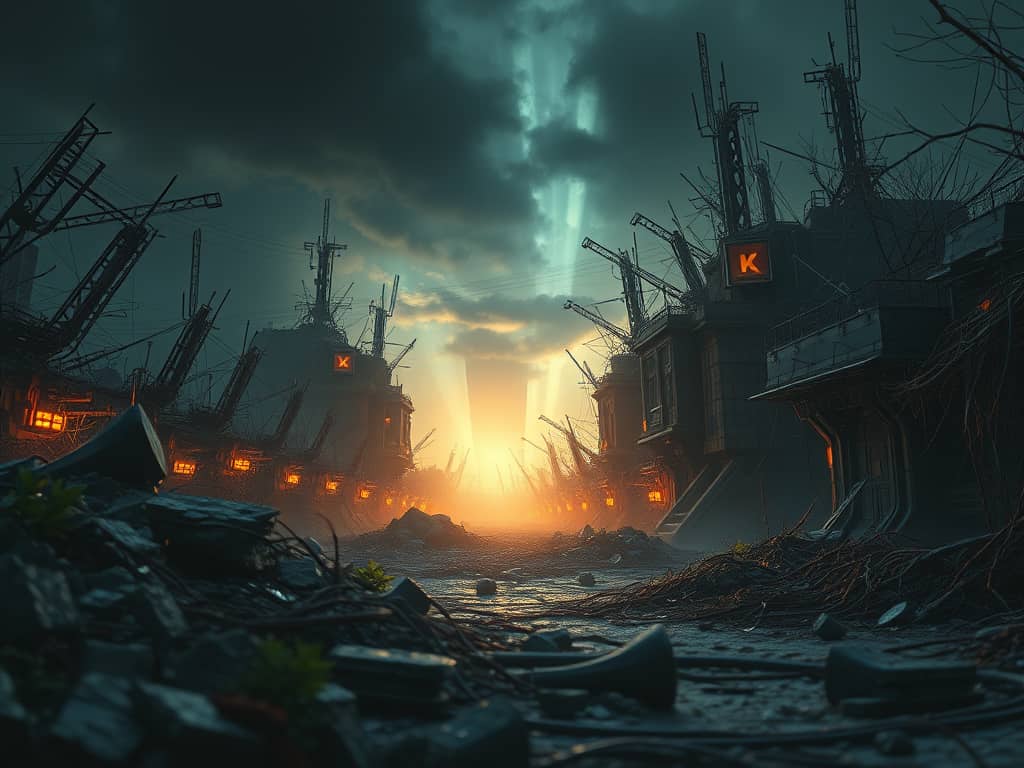
Humanity may be the dominant species on this planet, but we still face the threat of human extinction. That may take some believing, given our prevalence and superiority over other species, but the threat still remains.
There is a vulnerability to our existence, which means that our ongoing survival cannot be assured.
How might human extinction materialise? What could possibly threaten our commanding pre-eminence?
The danger may arise in one of two ways:
Firstly, if it were a mass extinction event. There have been several mass extinctions in the past, caused by events such as meteor strikes or volcanic eruptions. These cataclysmic events trigger a dramatic shift in the world’s climate, which many species are unable to adapt to, leading to mass extinctions.
Frankly, if something like this were to happen, there wouldn’t be too much that we could do about it. They are the extremes of Nature, beyond our control and beyond our defensive capabilities.
Some argue that burning fossil fuels threatens the next mass extinction event by causing significant global warming, which many species, including ourselves, would not be able to survive.
Whether or not we believe that this could threaten the existence of humanity depends firstly on whether or not we believe there is a link between the burning of fossil fuels and global warming, and secondly, on whether or not we believe that, as temperatures rise to dangerous levels, humanity could not step back from its damaging behaviour.
The second – possibly more compelling – threat to our existence is self-induced, more immediate and much more species-specific. It arises from the growing discord between humanity and our environment.
For a species to survive and prosper, it must be attuned to its environment. It must have the qualities needed to survive in that environment and to take full advantage of it.
Humanity’s great leap, the move that secured our ongoing survival, was the adoption of societal living. Living together meant we were better able to provide for our needs and protect ourselves from the harsh brutality of Nature.
Harnessing this evolutionary stride, we have gone on to promote and develop societal living to take full advantage of it, to the extent that society, rather than Nature, has now become our prevailing environment, our Living Environment.
It is to society’s needs that humanity will now be genetically adapting.
And that is where a problem may arise.
We are living through a technological revolution. It’s been sudden. It’s been rapid. And it also seems to be accelerating. The scientific and technological advances we are making are dramatically changing society. Our lives are very different to how they were just a few generations ago.
This may seem like progress, but from an evolutionary perspective, it carries risks.
In Nature, evolution is designed to be slow and subtle. It’s hardly noticeable. This is for a reason. It means that there is less disruption. As one species genetically adapts, changing the environment, others have the chance to make the necessary adjustments to ensure that they, too, can continue to survive. They have time to react, to develop their own coping evolutionary adaptations.
There is no sudden upheaval or shift in the prevailing environmental conditions. Most of the time, the balance of shared, mutual existence can continue.
Extinctions occur when there is a sudden, dramatic change in an environment.
Rapid environmental change is dangerous. It’s too disruptive. It doesn’t allow genetic adjustments. Hence, the discord. Hence, the possibility of an existential threat.
Humanity has failed to recognise that our technological revolution is a seismic shift in society – our Living Environment – and that, due to the measured processes of genetic evolution, we may not, as a species, be able to adapt to these new conditions. In such circumstances, genetically misattuned, our survival as a species could be threatened.
This is a real and present danger, given that we seem to be on a technological conveyor belt. We see technological advancement as progress. We see it as an enabling tool, meaning we have an insatiable thirst to further this development, to push at the boundaries of human knowledge and ability.
It seems our course is set, and there’s little we can do about it.
That’s not to say that there aren’t benefits to be had from such progress. We just need to be more aware of the risks that are involved.
If we just let technology flourish without adapting to it, there is a chance we will create a societal environment we are ill-adapted to, one we are alienated from. Individuals struggling with the latest technological advances, individuals excluded from aspects of society because they aren’t familiar with the new technologies, and individuals feeling lonely and isolated because they belong to a bygone age.
Faced with this looming threat and given our likely reluctance to abandon our drive for technological progress, perhaps we should embrace genetic engineering as a possible solution. We could spur on the necessary genetic changes to ensure that we maintain a harmonic relationship with our environment.
Our aim would be to fast-forward evolutionary adaptation, making substantive genetic advances in a single generation. Ideally, we would somehow focus on doing what Nature does, but just try to speed it up.
There’s certainly an appeal to doing this. Engineering success would also enable us to further demonstrate our technological prowess.
However, there are dangers with this as well. In pursuing such a course, we would be engaging in the creative process, shaping ourselves according to our own rules and desires. We would be deciding what we wanted to be like. Humanity would be acting as some kind of God. As such, we would be subject to our various prejudices, predilections and whims.
There would also be no guarantee that we could achieve our aims, that we could maintain a balanced relationship with our evolving environment.
Furthermore, by pursuing genetic engineering as a means to ensure our compatibility with a technologically transformed environment, we would be avoiding many of Nature’s inherent evolutionary safeguards. There are reasons why the process of genetic change is slow, piecemeal, peripheral and marginal. They help to prevent instability, disruption and breakdown.
Our involvement in genetic engineering would just not be compatible with the normal rules of evolutionary development.
There would also be wider consequences. We may be able to reshape or accelerate our own development, but we wouldn’t necessarily be able to do it for the rest of the natural world. Other species (flora and fauna) would suffer as they fail to adapt to a changing environment shaped by humanity’s societal structures.
It seems that, whatever course we choose, whether we continue to relentlessly pursue our enthusiasm for technological advancement or whether we seek to involve ourselves in shaping our human development to offset our technological progress, there are risks to our future.
Undoubtedly, as a species, we will struggle to adapt to our current rate of societal change. Our survival cannot, therefore, be assured.
For other interesting blogs on this subject area, check out Articles or the Article Index
Leave a Reply