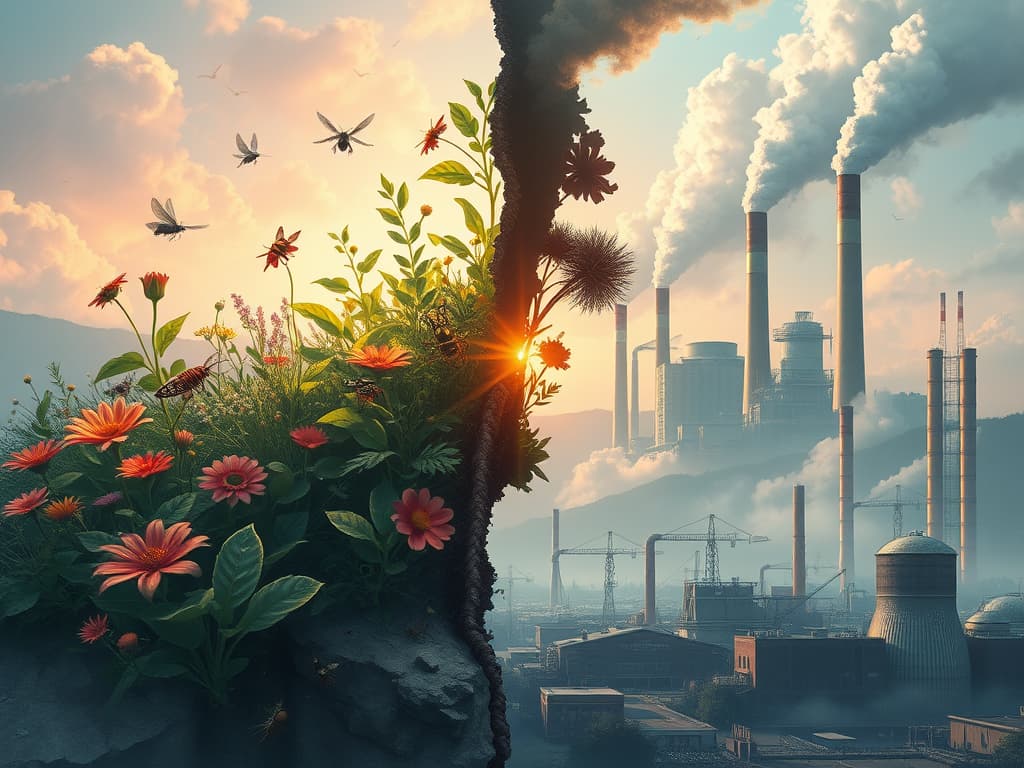
Although we may dispute the extent of the damage humanity has caused to both Nature and the environment, there is no disagreement that humanity has certainly had an effect on the world around us. Our human impact on Nature has been significant.
Our actions have had consequences. All actions have consequences.
In Newtonian law, a body will remain at rest or in motion until it is acted upon by an external force. In Nature’s recent evolution, humanity has often been that external force. Whatever we do, there’s always a “knock on”, ripple effect.
The repercussions of our actions can be substantial, widespread and far-reaching.
A change in one species will affect others in direct contact with it, but it will also affect ancillary species as the reverberations of any change are felt.
Although we might not always see it or be aware of the full consequences, the impact of any change is unlimited. It works its way both across and down the species hierarchy.
And, significantly, once change happens, it is both unstoppable and irrevocable.
Humanity – whether deliberately, incidentally or accidentally – has had an immediate and direct effect on our environment, but it has also, due to the “knock on”, cumulative effect, had a more subtle, secondary impact. There have been collateral implications and consequential repercussions.
Our actions might be minor or major; they might be micro or macro (what we do as individuals or as a species). Either way, they affect the lives of others.
If we plant a new shrub in our garden, it will create an environment where certain types of insects can thrive. Prior to the planting of this shrub, those insects would not have been able to exist.
If humanity continues to burn fossil fuels at an increasing rate, this will lead to further global warming, altering environmental conditions and obliging other forms of life to adapt to ensure their ongoing survival.
Whether or not it is driven by humanity, environmental change in itself isn’t such a bad thing. It’s like an economy having some inflation. A low, stable rate of inflation is beneficial. It means, amongst other things, that people are not tempted to delay purchases because of falling prices. It thereby encourages consumer demand.
Similarly, environmental change stimulates genetic adaptation and drives development.
The issue, the danger – whether it be environmental change or inflation – is when the rate of change becomes too great, too sudden or too unrelenting.
This is where we need to consider humanity’s involvement. As societies have developed and grown, humanity has been the principal driver of environmental change.
It can’t be helped. We are driven by one of Nature’s abiding principles, a basic instinct – Nature tends to make us behave in our own best interests. We will do what is good for us, what is beneficial for our genes. This, as with all species, is our primary motivator and driver.
Nature, therefore, encourages us – as with all species – to adopt selfish behaviours.
It is by strengthening our own position in Nature that we are better placed to secure our longer-term survival.
Remembering Newton’s second law, the acceleration of an object is directly proportional to the net force acting upon it and inversely proportional to its mass. Species change – evolution – is driven by the same principle.
Mass is our strength as a species. It is our defence against the forces of change. Given that we are in a constant fight with nature, we aim to build our strength to ensure we are resistant to change.
Doing this, doing what is right for us, can be harmful or damaging to others. Again, according to Newton, every action has an equal and opposite reaction.
Our own positive development will have a negative effect elsewhere. Our success inevitably means that others suffer, others regress, and others fail.
That is not our fault. It’s just the way Nature works.
In the past, we have not been too concerned with the less agreeable consequences of our behaviour. We have been too focused on our own survival and well-being. If other species suffer or even perhaps become extinct, then so be it. We must do what we have to do in order to secure our own existence.
But now, in these supposedly more enlightened times, we are much more aware of the impact we are having on the world around us. And we are not always comfortable with the effects of our actions.
In fact, we tend to have a rather guilty conscience. We look around and see how we are changing the world: dense human population centres, declining natural habitats, the cultivation of vast acreages, the pollution of the atmosphere, and the appropriation and exploitation of the world’s natural resources.
Many will argue that we are vandalising or destroying too much of Nature in order to maintain our own existence.
The guilt we carry for the negative impact we have on the world is exacerbated, not because it arises directly from our fight with Nature, from our struggle to survive, but because it stems from our seeking a better quality of life.
Our lifestyle choices are impacting Nature and the environment.
Examples include: our willingness to transport fresh fruit across the world to ensure its constant availability on the supermarket shelf, our need for transport to provide unlimited mobility for us, or even just our sheer love of consumerism.
Uncomfortable with our impact on the world, many of us will try to do something about it to assuage our guilt and ease our conscience.
Rewilding programmes, organic farming, animal sanctuaries, conservation schemes, animal releases, litter picks and charitable donations. We like to think that we are making a positive difference, supporting Nature, and giving something back.
That may be the case, but too often we don’t appreciate that whenever we get involved – even in these supposedly positive ventures – we are still altering the state of Nature.
There is always a delicate balance within Nature. All change has consequences. Any change alters that balance. So, although we might be full of good intentions, we do not always recognise and appreciate the full implications and effects of our involvement.
A further notable consideration is that, significantly, our actions will leave their own mark on Nature. They carry our human bias. Ultimately, we do what we do because it is good for us; we do what we do because we want our world shaped in a particular way.
Our recovery programmes carry our bias.
- We only support projects that may benefit us. For example, releasing beavers to assist our flood defences.
- We support those species with which we have an affinity. Pandas are cute, so we work to ensure their survival. If wasps were an endangered species, how much effort would we put into ensuring their survival?
- We only have regard for those species that we see. Those unseen species – bacteria, microorganisms – tend to go unnoticed and therefore unsupported, yet they are an important part of our ecosystem.
Our innate bias directs our good intentions. It means that we are not necessarily doing our best for Nature; we are still doing what works for us.
We should recognise that our actions have implications. Those implications can be significant. Nature drives our progressive development, but there is a danger that it could get out of control, that we could push it too far, that, in pursuance of our own well-being, we do untold, irreparable damage to the wider world.
For other interesting blogs on this subject area, check out Articles or the Article Index
Leave a Reply